Tuesday, January 23, 2024

The Gnome-Mobile


History and Review by Michael J. Ruhland

Year Released: 1967
Michael's Movie Grade: B

History

With the studio's cinematic focus having been on slapstick comedies, it had been quite a while since Disney had made a feature length fantasy film, despite this being the genre the Disney studio is most associated with. The Gnome-Mobile was a return to the fantasy genre. It also marked the last feature length fantasy film that Walt Disney himself would work on. 

For this return to fantasy filmmaking, the director would be Robert Stevenson, who directed two of Disney's best live action fantasy films, Mary Poppins (1964) and Darby O'Gill and the Little People (1959). His other movies for Disney include Johnny Tremain (1957), Old Yeller (1957), Kidnapped (1960), The Absent Minded Professor (1961), In Search of Castaways (1962), Son of Flubber (1962), The Misadventures of Merlin Jones (1964), The Monkey's Uncle (1965), That Darn Cat (1965), Blackbeard's Ghost (1968), The Love Bug (1969), Bedknobs and Broomsticks (1971), Herbie Rides Again (1974), The Island at the Top of the World (1974), One of Our Dinosaurs is Missing (1975) and The Shaggy D.A. (1976).

The cast is also full of familiar faces to Disney fans. The main kids in this movie are played by Karen Dotrice and Matthew Garber, who are best remembered for playing the Banks children in Mary Poppins. This was the last Disney role for both of them. Their grandfather was played by one of the finest character actors ever, Walter Brennan. He will be immediately familiar to classic movie fans for his roles in such classic films as The Westerner (1940), Sergeant York (1941), To Have or Have Not (1944), My Darling Clementine (1946), Red River (1948), The Far Country (1954), and Rio Bravo (1959) among many, many more. He had previously appeared in the Disney film, Those Calloways (1965). After this movie, he would appear in the Disney film, The One and Only, Genuine, Original Family Band (1968). The Gnome-Mobile also marks the last film appearance of Ed Wynn. A wonderful comedian, Ed had been in such Disney films as Alice in Wonderland (1951, as the voice of The Mad Hatter), The Absent Minded Professor (1961), Babes in Toyland (1961), Son of Flubber (1962), Mary Poppins (1964), Those Calloways (1965) and That Darn Cat (1965). Ed Wynn would pass away before this film was released. 

This movie was a moderate success at the box office. Critics were mostly mixed on the film. Some praised it for its performances and special effects, while others criticized its story and characters. Howard Thompson called the film, "good natured but heavy-handed." Variety called it "amusing but uneven." Judith Crist just called it "a lot of fun." Roger Ebert (who gave this movie 3 out of 4 stars) captured the attitude towards the live action Disney films at the time. He wrote, "The kids are my colleagues in this enterprise. Once I made the mistake of seeing a Disney movie the first thing on a Friday morning when all the kids were in school. There were about nine people in the theater. Under conditions like that, what critic can decide if Disney is up to par? Disney films are made to please kids, not critics." In his book The Disney Films Leonard Maltin praised the film stating, "Perhaps time will open more people's eyes to the excellence of this zesty comedy-fantasy, which ranks among Disney's best." It was rereleased to theaters in 1976 and aired on the Disney anthology show in 1978. 


The car and a set from this film can be seen in the Gilmore Car Museum in Hickory Corners, MI. Walt Disney was friends with the owner and donated them as soon as the movie finished filming.


Review

A very charming little fantasy movie. 

There is a lot to really like about this movie. The fantasy elements are very well done. This film does exactly what a fantasy movie should do. It makes it fantasy elements feel completely believable. Not only that but it makes us want to live in this world and like for an hour and a half, we have entered the world of the film. Part of this is the unpretentious storytelling and part of this is the special effects. Even all these years later, the special effects still look fantastic. While the animatronic animals don't look very real, the gnomes still look fantastic. Even though this is a smaller scale film than Darby O' Gill and the Little People (1959), this is just a visual handsome a film as that movie. This is not only seen in the special effects but also in the settings. The characters may not be complex, but they are likable. This is especially true due to the performances from Walter Brennan, Matthew Garber and Karen Dotrice. They all bring a real charm to their performances, that just helps give the film a real likability. The big car chase scene here is excellent. It is exciting as an action scene and very entertaining as a comedy scene. It perfectly combines both the action and the slapstick to make a real highlight. 

The humor in this film is never truly laugh out loud funny (the closest it comes is the car chase). This is more the type of comedy that will make you smile than the kind that will actually make you laugh. It does work very well on this level though. 

This film can admittedly drag a few times. These is especially true of the scene with the girl gnomes. The scene isn't as funny or charming as the filmmakers seem to think it is and it goes on much too long. This film also suffers from a rather weak villain, that does little but stretch out a simple plot. 

While this is not a perfect film, it is a very charming little movie. 

Film Credits


Director: Robert Stevenson.
Screenplay: Ellis Kadison.
 Based on the book The Gnomobile by Upton Sinclair
Cast: Walter Brennan (D.J. Mulrooney, Knobby), Matthew Garber (Rodney Winthrop), Karen Dotrice (Elizabeth Winthrop), Richard Deacon (Ralph Yarby), Tom Lowell (Jasper), Sean McClory (Horatio Quaxton), Ed Wynn (Rufus), Jerome Cowan (Dr. Ramsey), Charles Lane ( Dr. Scoggins), Norman Grabowski (Male Nurse), Gil Lamb (Gas Attendant), Maudie Prickett (Katie Barrett), Cami Sebring (Violet).
Producers: Walt Disney, James Algar.
Music: Buddy Baker.
Songwriters: Richard and Robert Sherman.
Cinematographer: Edward Colman.
Editor: Norman Palmer.
Art Directors: Carroll Clark, William H. Tuntke.
Set Decorators: Emile Kuri, Hal Gausman.
Costume Designer: Bill Thomas.
Costumers: Chuck Keehne, Neva Rames.
Makeup Artist: Pat McNalley.
Hair Stylist:  La Rue Matheron.
Assistant Director: Paul Cameron.
Second Unit Director: Arthur J. Vitarelli
Sound Artists: Robert O. Cook, Dean Thomas.
Matte Artist: Peter Ellenshaw.
Special Effects: Eustace Lycett, Robert A. Mattey.


Thursday, January 4, 2024

The Adventures of Bullwhip Griffin


History and Review by Michael J. Ruhland

Year Released: 1967
Michael's Movie Grade: B+

History

The Adventures of Bullwhip Griffin was the last western to bear Walt Disney's name. True to the direction the Disney studio had been heading at this time, this film was much more comedic than the more dramatic Disney westerns of the 1950's. 

As well as the last western for Walt Disney, this would also be the last Disney film to be directed by James Neilson. Neilson's previous Disney films had included Sign of Zorro (1958), Summer Magic (1963), Bon Voyage (1962), and The Moon-Spinners (1964). The writer for this film was Lowell S. Hawley, who had written such Disney movies as The Sign of Zorro (1958), Swiss Family Robinson (1960), Babes in Toyland (1961), In Search of Castaways (1962) and A Tiger Walks (1964). He would later write the Disney film, The One and Only, Genuine, Original Family Band (1968). He also wrote various episodes of the Disney anthology show for TV. Though this is a live action film, there are a few animated interludes and special effects provided by the legendary Disney animator, Ward Kimball.

Roddy McDowall plays the lead here, though he had played a smaller role in That Darn Cat (1965), this is the first time he played a major role in a Disney film. He would later play large roles in the Disney films, Bedknobs and Broomsticks (1971) and The Cat From Outer Space (1978). He would also voice Mr. Soil in Pixar's A Bugs Life (1998). His other Disney credits include doing voices for episodes of the TV cartoons, Darkwing Duck and Gargoyles. Suzanne Pleshette plays the leading lady. She had previously been the leading lady in Disney's The Ugly Dachshund (1966). Her other Disney credits include Blackbeard's Ghost (1968), The Shaggy D.A. (1976) and voicing the character Zira in the direct to video movie, The Lion King II: Simba's Pride (1998). Outside of Disney, she is best known for playing Emily Hartley in The Bob Newhart Show and Annie Hayworth in Alfred Hitchcock's The Birds (1963). The younger brother is played by Bryan Russell, who played the main role in Disney's Emil and the Detectives (1964). Also in the cast is character actress, Hermione Baddeley. She had previously appeared in Disney's Mary Poppins (1964). Her future Disney credits include The Happiest Millionaire (1967) and The Aristocats (1970) as the voice of Madame. Judge Higgens is played by the great Karl Malden, who previously played the Reverand in Disney's Pollyanna (1960). Malden is a very celebrated actor among film buffs for his great performances in such movies as A Streetcar Named Desire (1951), On the Waterfront (1954), Birdman of Alcatraz (1962), Patton (1970) and many more. TV fans also know him for the lead role in the series, The Streets of San Francisco. The character of Quentin Bartlett was set to be played Tony Hancock. However due to erratic on-set behavior, he would be replaced by Richard Hayden. Disney fans might know Richard Hayden as the voice of the caterpillar in Alice in Wonderland (1951). 

When this film was released to theaters, it received mixed reviews from critics. Some enjoyed the comedy and performances, while others felt the film was too slow-paced. The movie did poor at the box office and would in 1971 appear on Disney's anthology TV show.  


Review

A delightful Disney comedy. 

After the last couple live action Disney comedies, it is great to see one that made me laugh out loud as much as I did here. So much of this film is full of great gags. These gags range from clever satire to out and out slapstick. The slapstick gags are often in the pure Mack Sennett style. This is to say they are completely over the top and impossible. More than any other live action Disney comedy, this film feels like a live action cartoon. These slapstick gags are provided with so much energy, enthusiasm and complete lack of pretention that it is simply hard not to have fun watching it. The climatic fight scene is one of the pure highlights here. It provides wonderful slapstick gag after wonderful slapstick gag. Each on builds on top of the last to become more over the top, silly and funny. The satire here is also wonderful as this movie does a great job of parodying various movie clichés. This is especially shown during the brief animated interstitials, which are delightfully but knowingly old fashioned. Those interstitials also feature some ballad type singing that wonderfully parodies a trope common in Westerns at this time. The humor doesn't sacrifice our two main characters here. Both Griffin and his young partner Jack are delightful characters. Though they are not complex characters, they are very likable characters, that we enjoy spending this journey with. Like all Disney movies of this era, the film benefits from a simply wonderful cast. When it comes to the actors and actresses there is not a weak link here. 

This film does have a couple flaws though. One is that for such a silly comedy, it can feel a little overlong and repetitive at times. Also, while our two main characters are great, much of the rest of the characters are often times too sidelined for us to get to know or care about. 

If you enjoy the live action Disney comedies, you should have a lot of fun watching this one. 

Film Credits 

Director: James Neilson.
Screenplay: Lowell S. Hawley.
Based on the book By the Great Horn Spoon by Sid Fleischman.
Cast: Roddy McDowall (Bullwhip Griffin), Suzanne Pleshette (Arabella Flagg), Bryan Russell (Jack Flagg), Karl Malden (Judge Higgins), Harry Guardino (Sam Trimble), Hermione Baddeley (Miss Irene Chesney), Liam Redmond (Capt. Swain), Cecil Kellaway (Mr. Pemberton), Joby Baker (Bandido Leader), Mike Mazurki (Mountain Ox), Alan Carney (Joe Turner), Parley Baer (Chief Executioner), Arthur Hunnicutt (Referee), Dub Taylor (Timekeeper), Pedro Gonzalez-Gonzalez (Pedro Gonzalez Gonzalez).
Producers: Walt Disney, Bill Anderson, Lou Debney.
Music: George Bruns.
Songwriters: Richard and Robert Sherman, Mel Leven and George Bruns. 
Cinematographer: Edward Colman.
Titles and Things: Ward Kimball. 
Editor: Marsh Hendry.
Art Directors: Carroll Clark, John B. Mansbridge. 
Set Decorators: Emile Kuri, Hal Gausman.
Costume Designer: Bill Thomas.
Costumers: Chuck Keehne, Neva Rames, Emily Sundby.
Makeup Artist: Pat McNalley.
Hair Stylist:  La Rue Matheron.
Assistant Director: John C. Chulay.
Second Unit Director: Arthur J. Vitarelli
Sound Artists: Robert O. Cook, Robert Post.
Matte Artist: Peter Ellenshaw.
Special Effects: Eustace Lycett.


Wednesday, December 13, 2023

Monkeys, Go Home!


History and Review by Michael J. Ruhland

Year Released: 1967
Michael's Movie Grade: C

History

By the time Monkeys, Go Home! was released in theaters, Walt Disney had passed away. However, movie-goers would still be treated to more films that had Walt's direct influence on them for over a year. The first feature length of Walt Disney's films to be released after his death was Monkeys, Go Home! Though this film was released after Walt's death, production had been completely wrapped up before his passing. 

This was the first and only theatrical feature film Andrew V. McLaglen directed for Disney. However, he would later direct a made-for-TV movie for the studio, Trail of Danger (1978). As a director, Andrew V. McLaglen is best known for his westerns. For TV he directed 116 episodes of Have Gun Will Travel and 96 episodes of Gunsmoke. He also directed western movies with such stars as John Wayne, Jimmy Stewart and Kirk Douglas. These films include McLintock (1963), Shenandoah (1965), The Rare Breed (1966), The Way West (1967), Chisum (1970) and Cahill U.S. Marshall (1973). He also directed John Wayne in a non-western Hellfighters (1968). The screen writer for this film was Maurice Tombragel, who had previously written Moon Pilot (1962) for Disney. That film had a comedic monkey in it. He had also written various episodes of the Disney TV anthology show (known at various times as Disneyland, Walt Disney Presents, Walt Disney's Wonderful World of Color, etc.). These include the Texas John Slaughter episodes, many of the Gallegher episodes, The Waltz King and The Tenderfoot. His work outside of Disney included many B-movies and TV westerns. 

This movie marked the last film role for Maurice Chevalier. Though Chevalier had been working in films since the silent era, his greatest movie successes were in early 1930's, when he appeared in many wonderful musical comedy films including some directed by Ernest Lubitsch. However today Chevalier is probally best remembered for his role in the Best Picture Oscar winner, Gigi (1958), where he sang the song Thank Heaven for Little Girls. He had previously appeared in the Disney film, In Search of Castaways (1962). Though Monkeys, Go Home! marked his last acting role, Chevalier would later sing the title song for the animated Disney feature, The Aristocats (1970). As well as his film work, Chevalier also recorded an album of Disney songs for the company's Disneyland Records. After appearing in That Darn Cat! (1965) and The Ugly Dachshund (1966), Dean Jones was becoming the Disney studio's top comedy star. Though this is the last time he appeared in a movie produced by Walt Disney, he would appear in many more live action Disney comedies that were produced after Walt's death. These films include Blackbeard's Ghost (1968), The Horse in the Grey Flannel Suit (1968), The Love Bug (1969), The Million Dollar Duck (1971), Snowball Express (1972), The Shaggy D.A. (1976), Herbie Goes to Monte Carlo (1977) and That Darn Cat (1997). 

This film was shot on the Zorro set, which had just been refurbished. Critic William Peper noted this stating, "It's shot on the back lot of the Disney studios so don't look for any authentic Gallic backgrounds." When this movie was released, most critics were rather harsh on it. They felt this that the movie relied too heavily on the comedy with the monkeys and that everything else took a strong back seat. Since the critics didn't find the comedy with the monkeys funny at all, naturally this gave them little to like about the film. However, critic Vincent Canby saw this film with a group of children and noted, "their fun, it seems, is derived, in direct proportion to the number of chimpanzees on hand." However, the film also did not do well at the box office, and it found its way on to Disney's anthology show in 1970. 


Review

This may be far from top-tier Disney but for what it is it is enjoyable enough. 

Even if they may not be complex, the main characters are quite likable and pleasant to spend some time with. Dean Jones and Yvette Mimieux make for a charming couple, and they have good chemistry with each other. The romantic storyline between them may not be anything we haven't seen before, but it works well enough. Maurice Chevalier is as a delightful as ever and adds a real charm to the film. While this may have been filmed on sets rather than on location, it is still a handsome and visually pleasing movie, like nearly all the Disney films of this era. 

For a slapstick comedy, the humor is quite hits and miss here. There are some decent laughs to be found here. This includes a surprising bit of political satire. While this satire is simplistic it does raise a few smiles and come with some good comedic lines. There are also some pretty good laughs in some of the scenes involving the priest, especially when first talks to our main character. However, the slapstick involving the monkeys is simply never as funny as it should be. An extended slapstick fight scene in the middle of the street was obviously intended to be one of the film's comedic highlights but it didn't even raise a laugh from me. 

With such a simple storyline, this film feels longer than it needs to be. There are definitely some moments where it drags and some scenes which seem to be there to extend the runtime. Also, the song Joie de Vivre is probably one of the least memorable songs that the Sherman Brothers wrote for a Disney movie. 

This is not a great film by any means, but for Disney fans there is enough here to enjoy. 

Film Credits 

Director: Andrew V. McLaglen.
Screenplay: Maurice Tombragel.
Based on the book The Monkeys by G.K. Wilinson
Cast: Maurice Chevalier (Father Sylvain), Dean Jones (Hank Dussard), Yvette Mimieux (Maria Riserau), Bernard Woringer (Marcel Cartucci), Clément Harari (Emile Paraulis), Yvonne Constant (Yolande Angelli), Marcel Hillaire (Mayor Gaston Lou), Jules Munshin (Monsieur Piastillio), Alan Carney (Grocer), Maurice Marsac (Fontanino), Darleen Carr (Sidoni Riserau).
Producers: Walt Disney, Ron Miller.
Assistant to Producer: Lou Debney.
Music: Robert F. Brunner, Cecil A. Crandall, Evelyn Kennedy.
Songwriters: Richard and Robert Sherman.
Cinematographer: William Snyder.
Editor: Marsh Hendry.
Art Directors: Carroll Clark, John B. Mansbridge. 
Set Decorators: Emile Kuri, Frank R. McKelvy.
Costume Designer: Bill Thomas.
Costumers: Chuck Keehne, Neva Rames.
Makeup Artist: Pat McNalley.
Hair Stylist:  La Rue Matheron.
Assistant Director: Tom Leetch.
Sound Artists: Robert O. Cook, Robert Post.
Matte Artists: Jim Fetherolf, Peter Ellenshaw.
Dialogue Supervisor: Flora Duane.
Animal Supervisors: Ralph Helfer, Stewart Raffill.


Monday, October 23, 2023

Follow Me Boys


History and Review by Michael J. Ruhland

Year Released: 1966
Michael's Movie Grade: B

History

It should come as no surprise that Walt Disney produced a feature length film dedicated to the boy scouts. Walt was not only a proud American, but he proudly supported any institution that helped people (especially children) become better citizens. He felt that the boy scouts did just this. This film was not the first time a piece of Disney media had boy scouts as a theme. In the animated short film, Good Scouts (1938), Donald Duck was a scout master leading Hewey, Dewey, and Louie on a hiking trip. In the comics (starting in 1954) Donald's nephews consulted their Junior Woodchucks Guidebook, which always seemed to have the answer to any question. A sweet and gentle feature film about the boy scouts was just a natural extension of who Walt was and what he believed in. 


This movie's director was Norman Tokar, who was very prolific as a Disney director. His first Disney film was Big Red (1962) and his last was The Cat from Outer Space (1978). Over his course of working at Disney he also directed such films as Savage Sam (1963), A Tiger Walks (1964), Those Calloways (1965), The Ugly Dachshund (1966), The Happiest Millionaire (1967), The Horse in the Gray Flannel Suit (1968), Rascal (1969), The Boatniks (1970), Snowball Express (1972), The Apple Dumpling Gang (1975), No Deposit, No Return (1976) and Candleshoe (1977). Like many of the live action Disney directors of this era, outside of Disney he was most prolific on television. Most famously he directed a whopping 93 episodes of the classic sitcom Leave it to Beaver. He also directed 22 episodes of The Donna Reed Show.  Louis Pelletier wrote the screenplay. He had previously written the Disney films Big Red (1962) and Those Calloways (1965). He would later write the Disney films, The Horse in the Gray Flannel Suit (1968), Smith! (1969), The Boy from Dead Man's Bayou (1971) and Run Cougar Run (1972). 

The star of this film is Fred MacMurray. MacMurry was already a staple in Disney movies by this time having already been in The Shaggy Dog (1959), The Absent-Minded Professor (1961) and Son of Flubber (1963). His child co-star was none other than Kirk Russell making his film debut. Kirk Russell would soon also become a regular in Disney's live action comedies. This film also saw the return of Launa Pattern to Disney. As a young kid, she became the first actress to have a contract with Disney. Her Disney career started with Song of the South (1946). Follow Me Boys marks her first Disney movie since Johnny Tremain (1957). This marked the last theatrically released movie for actor Charles Ruggles, whose career had spanned almost 100 feature films, beginning in 1929. To name a few movies, his filmography included Trouble in Paradise (1932), Alice in Wonderland (1933), Six of a Kind (1933), Bringing Up Baby (1938), The Invisible Woman (1940), A Stolen Life (1946) and It Happened on 5th Avenue (1947). For Disney he appeared in The Parent Trap (1961), Son of Flubber (1963) and The Ugly Dachshund (1966).

The title for this film was originally going to be On My Honor. However, when The Sherman Brothers wrote a song for this movie entitled Follow Me Boys, the title was changed. 

The film was released in theaters on December 1, 1966. Critics took to a strong dislike of the movie. Philip K. Scheuer of the Los Angeles Times stated, "like a movie that might have been made 30 years ago. In thinking, approach, technique and every other way it could pass for a revival of the dear dead days beyond recall, and I sat there unbelieving that this many cliches could not only have been remembered but actually presented as something new." Clifford Terry of the Chicago Tribune stated, "Admittedly, there probably are enough chuckles and sniffles to satisfy the most rabid Disney devotees, but stretched out for more than two hours, the film seems almost as long as the 20 years it covers. Decidedly, far more imaginative and amusing products have been fashioned by the talent in Walt's workshop." However, the film still was a hit at the box office, grossing around $6 million. The movie would be reissued to theaters in 1976, however that rerelease would have a much shorter run time. The film originally ran 131 minutes. However, this reissue would run only 107 minutes. 

Walt Disney would make his last filmed appearance before a special screening of Follow Me Boys. This introduction can be watched below. 


Review

A thoroughly charming movie.

This film is exactly what people think of when it comes to live action Disney films of this era. It is as wholesome and sweet as can possibly be. However, this film comes off as more charming than saccharine in its sweetness. That is because the sentimentality feels completely genuine and earned. Much of the reason this movie feels so earnest is because of its cast. Kurt Douglas is simply wonderful and natural in his first film role. He can even hold his own with a top-notch adult cast. Fred MacMurray is as wonderful as always, making even the corniest lines feel completely natural and believable. Him and Vera Miles have wonderful chemistry together and are perfectly charming every time they share the screen. Lillian Gish, one of the greatest actresses of all time, has a smaller role here, but is very memorable. Yet the cast isn't the only reason, this film is so charming. The script (while corny) does paint a very charming and lovely picture of small-town America. The way this film looks is equally charming. The outdoor scenes (filmed at the studio's Golden Oak Ranch) are simply beautiful to look at. These beautiful scenes make even the adults watching the film wanting to join the boy scouts. Even the indoor scenes (shot on the Disney Studio lot) have a wonderfully idyllic look to them. This film also benefits with from a delightfully fun and charming musical score by George Bruns and a very catchy title song by the Sherman Brothers (which constantly lives in my head). While there may be sometimes big gaps between laughs, there are some truly very funny moments in this movie, especially towards the beginning. 

The main problem with this film is overlength. For such a simple movie, there is no reason for it to be as long as it is. Because of this, there are times when it can really drag. This is especially true in the war games scene, which is not only too long but never as exciting or fun as the filmmakers seem to think it is. In fact a lot of the later part of this movie could have been cut but a truly heartwarming ending makes up for this. This film also is very predictable, and you almost always figure out what is going to happen before it happens. There are also some lines of dialogue (especially almost anything the bank president says about the boy scouts) that feel much too corny and unlike how anyone would actually talk. 

Despite its flaws, this is a very charming film that is a real delight for Disney fans. 

Film Credits

Director: Norman Tokar.
Screenplay: Louis Pelletier.
Based on the novel God and My Country by MacKinlay Kantor.
Cast: Fred MacMurray (Lemuel Siddons), Vera Miles (Vida Downey), Lillian Gish (Hetty Seibert), Charles Ruggles (John Everett Hughes), Elliott Reid (Ralph Hastings), Kurt Russell (Whitey), Luana Patten (Nora White), Ken Murray (Melody Murphy), Donald May (Edward White, Jr.), Sean McClory (Edward White, Sr.), Steve Franken (P.O.W. Lieutenant), Parley Baer (Mayor),  William Reynolds ( Hoodoo Henderson). 
Producers: Walt Disney, Winston Hibler
Music: George Bruns, Evelyn Kennedy, Walter Sheets.
Cinematographer: Clifford Stine.
Editor: Robert Stafford.
Art Directors: Carroll Clark, Marvin Aubrey Davis. 
Set Decorators: Emile Kuri, Frank R. McKelvy.
Costume Designer: Bill Thomas.
Costumers: Chuck Keehne, Neva Rames.
Makeup Artist: Pat McNalley.
Hair Stylist:  La Rue Matheron.
Assistant Director: Terry Morse Jr.
Sound Artists: Robert O. Cook, Robert Post.
Special Effects Artists: Eustace Lycett.
Matte Paintings: Jim Fetherolf.

-Michael J. Ruhland

Resources Used

The Disney Films by Leonard Maltin
http://www.thedisneyfilms.com/search/label/Follow%20Me%20Boys
https://www.imdb.com/?ref_=nv_home


Friday, September 8, 2023

The Fighting Prince of Donegal


History and Review by Michael J. Ruhland

Year Released: 1966
Michael's Movie Grade: B+

History

Despite Disney having got its start in live action filmmaking with a series of adventure films, at this time the studio had not done a real adventure film since Kidnapped (1960). Most of the studios live action movies at this time we’re silly family friendly comedies. With this in mind The Fighting Prince of Donegal is a bit of a return back to the roots of Disney live action filmmaking. This film would also like the early live action Disney films like Treasure Island, The Story of Robin Hood and His Merrie Men, The Sword and the Rose and Rob Roy: The Highland Rouge, would be shot entirely in the U.K. 

This film would be directed by Michael O’Herlihy, who like many Disney directors of this time period, had worked mostly in TV beforehand. He had directed episodes of such shows as Maverick, 77 Sunset Strip and The Man From Uncle. This was his first Disney movie. He would eventually direct two more films for the studio, The One and Only Genuine Original Family Band (1968) and Smith (1969). He would also direct some episodes of Walt Disney's Wonderful World of Color and The Wonderful World of Disney. This is the second and last Disney film for its two leads. Peter McEnery had previously been in The Moonspiners (1964) and Susan Hampshire had previously been in The Three Lives of Thomasina (1963). The film's writer, Robert Westerby had previously written the Disney films, Greyfriars Bobby (1963) and The Three Lives of Thomasina, as well as various episodes of the Disney TV series. 

This film received mixed reviews from critics and lost money at the box office. Due to this being an expensive film and losing money, the Disney studio would not make another swashbuckler until The Three Musketeers (1993). The film would appear on TV's Walt Disney's Wonderful World of Color in 1967, the year after it was released to movie theaters. 


Review

An excellent Disney swashbuckler.

I am personally a big fan of the Disney swashbucklers, and this movie has everything I love about them. The action scenes here are simply fantastic. They are fast paced, exciting and a lot of fun. Not only that, but the music accompanying them is perfect and helps build them up perfectly. The look of this film is very lavish and simply lovely to look at. This is especially true of Peter Ellenshaw's matte paintings and the elaborate sets. All of this gives the film a grand scale, that you could have not seen in a Disney comedy of this era. This lavish look will certainly remind Disney fans of many of the best live action movies that came out of the studio in the 1950's. It is great to see that by 1966, the Disney filmmakers where still just as capable of providing a visually beautiful adventure film as they were when they made The Sword and the Rose (1953), The Story of Robin Hood and His Merrie Men (1952) or Treasure Island (1950). This is not to say this movie is all style and no substance though. Much of the dialogue here is very clever and intelligent, often on par with the Warner Brothers swashbucklers of the 1930's and 40's. The story, while simplistic is quite engaging. The characters (while not exactly deep), serve their roles in this film very well. I especially like how our main hero, has his flaws along with being brave and a good leader. He can lose his temper at times, and this makes him feel much more real and relatable to us. The romance (while not given much screen time) is very well done and completely believable. 

I will admit that this film could have used a bit more editing, as some scenes feel unnecessary and even repetitive. This movie also tries to keep a lighthearted tone for much of it. Because of this it has a greater emphasis on humor than some of the previous Disney swashbucklers. Unfortunately, this humor often simply doesn't work and can even slow the story down. 

All in all, this is an excellent return to swashbucklers for Disney and I wish the studio would have made more after this. 


Film Credits


Director: Michael O'Herlihy.
Screenplay: Robert Westerby.
Based on a book by Robert T. Reilley.
Cast: Peter McEnery (Hugh O'Donnell), Susan Hampshire (Kathleen McSweeney), Tom Adams (Henry O'Neill), Gordon Jackson (Captain Leeds), Norman Wooland (Sir John Perrott), Richard Leech (Phelim O'Toole), Peter Jeffrey (Sergeant), Marie Kean (The Mother), Bill Owen (Officer Powell), Peggy Marshall (Princess Ineen), Maurice Roëves (Martin), Donal McCann (Sean O'Toole), Fidelma Murphy (Moire). 
Producers: Walt Disney, Ron Miller, Bill Anderson.
Music: George Bruns, Eric Rogers, Walter Sheets.
Cinematographer: Arthur Ibbetson.
Camera Operator: Freddie Cooper.
Editor: Peter Boita.
Art Directors: Maurice Carter.
Set Decorator: David Ffolkes.
Costume Designer: Anthony Mendleson.
Makeup Artist: Harry Frampton.
Hair Stylist:  Eileen Warwick.
Assistant Director: David Bracknell.
Sound Artists: Peter Keen, Gordon K. McCallum, Ken Rawkins.
Special Effects Artists: Peter Ellenshaw.
Matte Paintings: Peter Ellenshaw.

Resources Used

The Disney Films by Leonard Maltin
http://www.thedisneyfilms.com/search/label/Fighting%20Prince%20of%20Donegal%20%28The%29
https://www.imdb.com/title/tt0060408/?ref_=ttfc_fc_tt


Tuesday, August 8, 2023

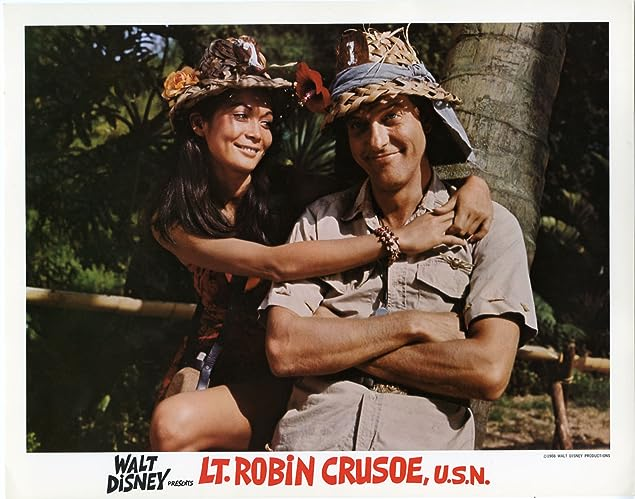
Lt. Robin Crusoe U.S.N.

History and Review by Michael J. Ruhland


Year Released: 1966
Michael's Movie Grade: C+


                                          History

While making Mary Poppins, Walt Disney and Dick Van Dyke got along very well. With this Walt wanted to work with Dick again.


This film is the only Disney feature where the story is credited to Walt himself. However the onscreen credit does not refer to Walt by name. Instead it states "Retlaw Yensid", or Walter Disney backwards. The director of this film was Byron Paul. Paul was mostly a television director working on such shows as Gunsmoke, The Jane Forman Show, My Favorite Martian, Omnibus and Have Gun Will Travel. More important to this film he directed some episodes of Walt Disney's Wonderful World of Color and would later become the producer of The New Dick Van Dyke Show. Dick Van Dyke's co-star Nancy Kwan was a major star at this time. She had made her film debut in 1960 with The World of Suzie Wong, playing the title character. That movie had been a huge success and Nancy soon found herself as a major Hollywood star. The next year she made another movie in the lead role, Flower Drum Song (1961) and her star continued to rise.  

Though this was the only time director Byron Paul would direct a theatrically released Disney film, he had directed episodes of TV's Walt Disney's Wonderful World of Color. This is actually the only theatrically released film that Byron Paul directed. Like many of the live action Disney directors of this time period, Paul was much more prolific when it came to TV. He directed episodes of such shows as 77 Sunset Strip, Ben Casey, Have Gun Will Travel and My Favorite Martian. Lt. Robin Crusoe USN was not the last time Paul would work with Dick Van Dyke as he would later be an executive on TV's The New Dick Van Dyke Show

During the filming of this movie, Walt took his family on a Hawaiian trip while a week of location shooting was done there. Walt's daughter Diane would remember, "The location was a wonderful time for us. We spent about three weeks at the Waiohai Hotel with mom and dad, Bill and Nolie Walsh, Bryon Paul and his family. The Van Dykes were a wonderful family. Dick's a superb human being as well as a great talent." Though there was this week of location shooting there, most of the film was shot in San Deigo with some interior shooting at the Disney studio. 


This movie was not exactly a critical success. Even critics who were fans of Dick Van Dyke, thought this movie tended to drag. Arthur Knight (who was a fan of Van Dyke) wrote in his review in Saturday Review, "There is no variety to his playing, no zest (or possibly too much zest) to his performance. Inevitably some things work out nicely, such as a protracted bit of charades played with Nancy Kwan; but this seems to be one of the few scenes that permit the buoyant Van Dyke personality to bubble through." Howard Thompson wrote in his review in The New York Times, "Most of the picture has Mr. Van Dyke mugging and tripping over lush scenery. It is neither very funny nor very new and the picture is recommended with reservations, only for the very, very young and for television fans who think Mr. Van Dyke can do no wrong." Despite this though audiences went to see this movie in big numbers and the film became a huge hit, grossing nearly $8 million. 

This movie premiered on the Kitty Hawk, an aircraft carrier that part of the movie was filmed in, on June 29th, 1966. The audience for this premiere included only the crew of the ship and those that worked on the film. General audiences first got to see the film on July 29th of that year. In theaters it was paired with the live action Disney short film, Run, Appaloosa, Run.


Review

An enjoyable comedy, but far from one of Disney's best. 

So much of this movie working depends on the charm of its two leads. Luckily both of them are great here. Both Dick Van Dyke and Nancy Kwan bring a real likability to this film. They are simply a joy to watch on the screen and can even carry many of this film's weaker moments. Not only this but the two play off each other very well. The best scenes are the ones that involve these two playing off each other. The (often one sided) romantic tension between the two is also handled quite well feeling very natural and charming. It also helps that they are some moments here that are truly funny, such as the charade scene and some of the scenes involving Crusoe training the army of women. There is also a real easy-going charm to much of this movie. The film also has a strong start and a strong end. To start and close strong is often one of the most important elements to a comedy. 

The main problem with this film is overlength. For such a simple storyline there is no reason for it to be as long as it is. While there are some genuinely funny moments there can also be too long of periods between laughs. Because of this the film can really drag at times. For instance the time between when our main character lands on the island and when he meets Nancy Kwan's character seems much longer than it is. Much of this is due to an unnecessarily slow pace and some not especially funny jokes. Much of the reason the jokes during this part don't play well is that Dick Van Dyke's clowning often works better when he has someone to play off of and the chimp and the bird don't fill this position as well as Nancy Kwan does later in the film. The climax of this film (despite some good gags and clever ideas) suffers from a hammy and kind of annoying performance by Akim Tamiroff as the villain and some incredibly dated special effects. 

I doubt this will be anybody's favorite of the live action Disney comedies, bur it is still an enjoyable watch. 

Film Credits

Director: Bryon Paul.
Story: Walt Disney. 
Screenplay: Don DaGradi, Bill Walsh.
Based on a book by Daniel Dafoe.
Cast: Dick Van Dyke (Lt. Robin Crusoe), Nancy Kwan (Wednesday), Akim Tamiroff (Tanamashu), Arthur Malet (Umbrella Man), Tyler McVey (Captain), Peter Renaday (Pilot), Peter Duryea (Co-Pilot), John Dennis (Crew Chief), Nancy Hsueh (Native Girl), Victoria Young (Native Girl), Yvonne Ribuca (Native Girl), Bebe Louie (Native Girl), Lucia Valero (Native Girl)
Producers: Walt Disney, Ron Miller, Bill Walsh.
Music: Robert F. Brunner, Evelyn Kennedy, Cecil A. Crandall
Cinematographer: William E. Snyder.
Camera Operator: Robert King Baggot.
Editor: Cotton Warburto
Art Directors: Carroll Clark, Carl Anderson.
Set Decorators: Emile Kuri, Frank R. McKelvy.
Costume Designer: Bill Thomas.
Makeup Artist: Pat McNally.
Hair Stylist:  La Rue Matherson.
Assistant Director: Tom Leetch.
Second Unit Director: Joseph L. McEveety.
Sound Artists: Robert O. Cook, Larry Jost.
Special Effects Artists: Eustace Lycett, Robert A. Mattey, Peter Ellenshaw, Jack Boyd.
Animal Supervisor: Stewart Raffill

Resources Used

The Disney Films by Leonard Maltin
Travels With Walt Disney by Jeff Kurti
http://www.thedisneyfilms.com/search/label/Lt.%20Robin%20Crusoe%20U.S.N.
https://www.imdb.com/title/tt0060640/?ref_=ttfc_fc_tt


Friday, April 13, 2018

The Ugly Dachshund

History and Review Written by Michael J. Ruhland


Year Released: 1966
Michael's Movie Grade: C+

HistoryThis movie was based off a 1938 book by Gladys Bonwyn Stern with the same name. It is no surprise that this book would inspire a Disney movie considering that it is a silly comedy book involving animals. For a director Walt put Norman Tokar in charge. Tokar had already directed such Disney films as Big Red, Savage Sam, A Tiger Walks and Those Calloways. The writer of this film was Albert Aley and this was the only theatrical feature he ever wrote. Aley did much more work for TV writing episodes of shows like Ironside, Rawhide, The Man From U.N.C.L.E., The Rifleman and Have Gun- Will Travel. The cast included Dean Jones (just off his role in That Darn Cat), Suzanne Pleshette and Disney regular Charles Ruggles. This was Suzanne Pleshette's first Disney role. She would later be in The Adventures of Bullwhip Griffin, Blackbeard's Ghost and the Disney supervised English dub of Spirited Away. Probably her best remembered role today is as Annie Hayworth in Alfred Hitchcock's The Birds. The Ugly Dachshund was the last film for actor Dick Wessel. He died after principal photography was finished. Still after he passed some lines needed to be re-dubbed. Paul Frees was hired to do this dubbing. Disney fans might know Frees as the voice of Ludwig Von Drake and The Ghost Host in The Haunted Mansion ride. Cartoon fans might know him as the voice of Boris Baddenoff, Rocky and Bullwinkle's archenemy.    

To play the role of the Great Dane, Brutus, one of the animal trainers found a 3 year old prize winning dog named Diego of Martincrest. Some scenes however required a dog with more experience. So a dog named Duke was his stunt double. Duke was no newcomer to Disney movies as he had previously appeared in Swiss Family Robinson.

The Ugly Dachshund was released with the Disney cartoon short, Winnie the Pooh and the Honey Tree. Critics though more of the short film than the feature. A review for The New York Times wrote "Three cheers for Winnie the Pooh! The Ugly Dachshund? He'll do." Other critics were much harsher. A review in Time magazine stated "Such comedies as this one are too wholesome for kids, too foolish for dog fanciers and a sure way to persuade young adults that movies filled with sex and violence can't be all bad." Yet audiences sure went to see this film. It earned $6 million at the box office.


Review
An enjoyable comedy, but certainly far from the excellence of earlier Disney live action comedies.

While this may not be a Disney classic, there are certainly things to enjoy here. Mark is a quite likable character. We can always relate to him and sympathize with him. This film also features some good comedy set pieces. The beginning with the traffic cop, Fran keeping Mark up all night naming the puppies, the big party and the dog show are all funny and highlights. The story also has a simple and undeniable charm.

While this movie does have some good comedy set pieces it also has some very weak ones. Watching the puppies wreck Mark's art studio is simply not funny at all. We like Mark and seeing these puppies not only destroy his studio, but to see his beloved Brutus get blamed for it leaves little to laugh about and seems annoying instead. The scene involving a ball of yarn has the same effect. A very embarrassing birthday party offers little humor as well.

 The Ugly Dachshund is probably the safest movie Disney made during this period. As such there is little to make it stand out among the studio's great output. Still there is a fun little movie, even if it can't hold its own with The Parent Trap, The Absent Minded Professor or That Darn Cat.

Credits
Director: Norman Tokar.
Writer: Albert Aley.
Cast: Dean Jones (Mark Garrison), Suzanne Pleshette (Fran Garrison), Charles Ruggles (DR. J.L. Puritt), Kelly Thordsen (Officer Carmody), Parley Bear (Mel Chadwick), Robert Kino (Mr. Toyama), Mako (Kenji), Charles Lane (Judge).
Producers: Walt Disney, Winston Hibler.
Music: George Burns, Evelyn Kennedy, Franklyn Marks.
Cinematographer: Edward Colman.
Editor: Robert Stafford.
Art Directors: Carroll Clark, Marvin Aubrey Davis.
Set Decorators: Emile Kuri, Frank R. McKelvy.
Costume Designers: Gertrude Casey, Chuck Keehne.
Makeup Artists: Pat McNally, La Rue Matherson.
Assistant Director: Tom Leetch.
Second Unit Director: Arthur J. Vitarelli.
Sound Artist: Robert O. Cook.
Special Effects Artist: Eustace Lycett.
Dog Trainers: William R. Koehler, Glen Randell Jr.

Resources Used
The Disney Films by Leonard Maltin
http://www.imdb.com/title/tt0061135/?ref_=ttfc_fc_tt
http://www.tcm.com/tcmdb/title/94305/The-Ugly-Dachshund/articles.html
http://www.thedisneyfilms.com/search/label/Ugly%20Dachshund%20%28The%29
Disney A to Z: The Official Encyclopedia by Dave Smith.

-Michael J. Ruhland